News + Resources
Industry news, Astaara press releases & maritime cyber risk resources
- Purpose
The purpose of this memorandum is to share information with our shipowners and brokers on known developments within the Persian Gulf from an operational / cyber and insurance perspective. Sources of the content are MTO and associated agencies.
- 03 Mar 2026: Astaara’s views on Middle East war discussion
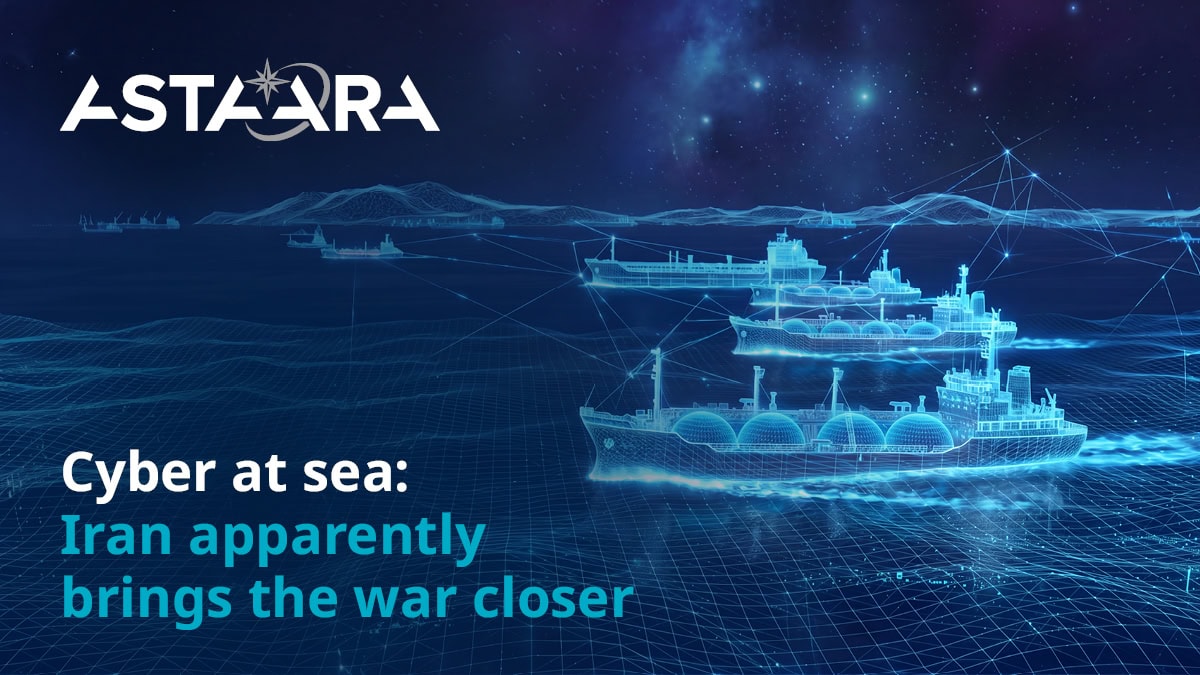
The 28th Feb 2026 and onwards ‘Epic Fury’ attacks on Iran by Israel and the US will almost certainly increase the cyber threat regionally in the medium term. Other, possibly non-regional, hostile actors may be encouraged in the ‘fog or war’ to attack elsewhere while masking their true intentions. As the kinetic conflict continues, competent authorities are also reporting an increase in GNSS spoofing and jamming, requiring Masters and crews to be extra vigilant and cautious in their navigation.
The majority of inbound attack will continue to be kinetic, and while we are aware that Israeli and US forces have sought significantly to degrade Iran’s infrastructure through cyber means, ongoing vigilance will be necessary to ensure that any vulnerabilities on vessels are not exploited as Iranian offensive cyber capability is restored over the coming weeks. Houthi rebels will also continue to attack shipping to further their agenda.
The UK NCSC cautions that while there is no direct increase in the cyber threat to the UK from Iran now, this may change rapidly. They believe there is ‘almost certainly’ a heightened risk of indirect cyber threat for those organisations and entities who have a presence, or supply chains, in the Middle East. And Iranian state and Iran-linked cyber actors almost certainly currently maintain at least some capability to conduct cyber activity.
The UK MTO continues to report multiple cases of significant GNSS and electronic interference across the Arabian Gulf, with potential impacts to positioning, navigation, and communications systems, including AIS and VHF. It warns that interference may be intermittent and unpredictable.
- UK MTO 01 March Report
Update 002: The maritime security environment across the Arabian Gulf, Gulf of Oman, North Arabian Sea, Bab al Mandab (BAM), and the Strait of Hormuz remains highly volatile, with ongoing regional military activity contributing to elevated threat to commercial shipping. There is significant military presence and activity across the region. Mariners should be aware of the increased risk of miscalculation or misidentification, particularly in proximity to military units and other sensitive maritime facilities and infrastructure, as well as the potential for VHF hailing and directed communications.
Broader regional instability continues to present threats beyond the Strait of Hormuz, including in areas such as the Bab al Mandab, where tensions remain elevated. Claims regarding the closure of the Strait of Hormuz continue to circulate via open source reporting and VHF communications. No official closure of the Strait of Hormuz has been formally communicated to the maritime industry through recognised maritime safety channels, including NAVAREA warnings or IMO recognised Maritime Safety Information broadcasts. VHF communications indicating transit restrictions do not constitute a legally recognised suspension of transit passage under international maritime law, including UNCLOS.
In addition, multiple reports indicate significant GNSS and electronic interference across the Arabian Gulf, with potential impacts to positioning, navigation, and communications systems, including AIS and VHF. Interference may be intermittent and unpredictable.
JMIC guidance to mariners:
- Maintain a continuous listening watch on VHF Channel 16.
- Ensure AIS transmission in accordance with company policy.
- Strictly adhere to established Traffic Separation Schemes and recognised transit corridors.
- Expect potential VHF hailing from military units and be prepared to respond professionally.
- Conduct enhanced risk assessments prior to transit, taking into account regional military activity and insurance considerations.
- Immediately report unusual activity, suspicious approaches, electronic interference, or incidents to UKMTO or other recognised reporting centres. The situation continues to be monitored closely.
Further updates will be issued as information becomes available.
- Astaara Insurance market update
The AstaaraCyber Marine policy is not cancelled and provisions for such do not apply within the current iteration of the policy. Thus cover continues, and brokers are reminded that cover for Terror and Confiscation risks are covered by virtue of carve outs from Cyber War Exclusion as per AstaaraCyber Conditions 2.0.




Astaara Underwriting UK Limited is an appointed representative of Davies MGA Services Limited, a company authorised and regulated by the Financial Conduct Authority under firm reference number 597301 to carry on insurance distribution activities. Astaara Underwriting UK Limited is registered in England and Wales company number 12570450. Registered office at 5th Floor 20 Gracechurch Street, London, United Kingdom, EC3V 0BG.
